Wooden Window Sill Replacement
The window sill is the part of a timber window that takes the worst of the weather — standing rainwater, sun, frost cycles, and any moisture wicking up from the wall below. When a sill fails, it does so dramatically: paint peels, timber splits, and rot spreads sideways into the frame and jambs.
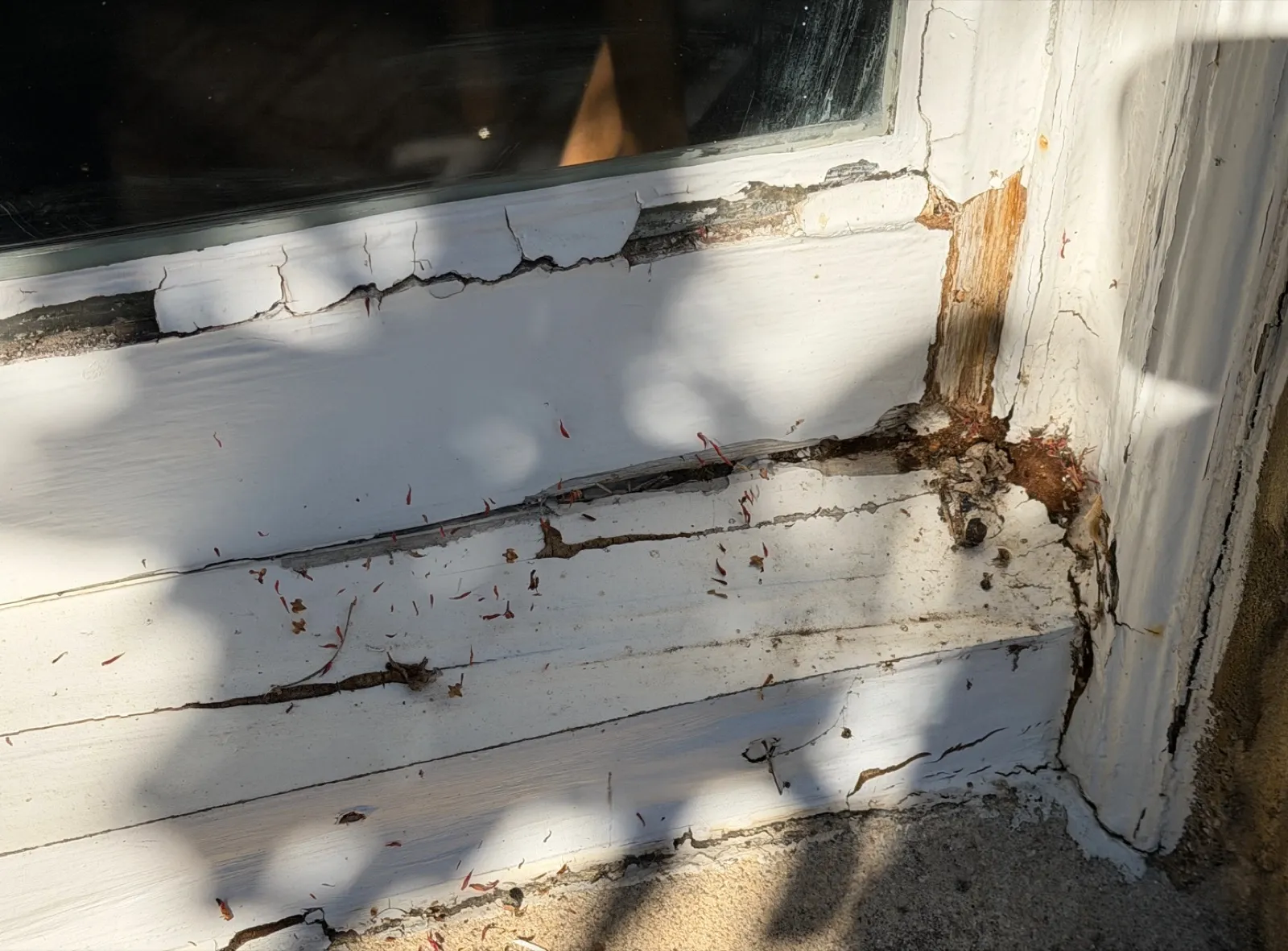
The sill above is past the point of patch-repair. The horizontal surface is splitting into multiple layers, the corner where it meets the jamb is fully exposed and softened, and water is now running freely behind the paint. Left another season, the rot will reach the frame and the cost of repair triples.
When a sill needs replacing (vs repairing)
Not every weathered sill needs the chainsaw. Our on-site assessment determines which approach is right:
- Spot repair — for small areas of softened timber (under 20cm² and shallower than 1cm) we can cut out the rot and consolidate with marine-grade epoxy filler. Cheapest option, lasts 10+ years if maintained.
- Sill end splice — if the rot is concentrated at one or both ends (where the sill meets the brickwork or jamb), we can splice in Accoya® sections matching the original profile. Cheaper than full replacement and visually invisible once painted.
- Full sill replacement — for sills like the one above, where the structural integrity is gone across most of the length, we cut out the entire sill, treat the frame and jambs, and fit a new Accoya sill machined to match the original profile, drip groove and weatherings.
Why Accoya for replacement sills
Most original sills on Victorian and Edwardian properties were redwood pine or softwood — cheap, plentiful, but with a 30–50 year lifespan in exposed exterior use. We replace with Accoya®, an acetylated softwood with the durability of teak:
- 50-year warranty against rot and fungal decay even in fully exposed exterior use.
- Dimensionally stable — doesn't shrink, swell or twist with seasonal moisture, so paintwork doesn't crack along expansion lines.
- Workable like normal softwood — we can match any historic profile (ovolo, lamb's tongue, weathered, drip-grooved).
- Holds paint exceptionally well — the acetylation process gives a more uniform surface that primer bonds to permanently.
Our sill replacement process
- On-site assessment — profile, depth, length and condition of the surrounding frame measured. Free quote.
- Workshop machining — new Accoya sill cut to length and machined to match the original moulded profile, including drip groove on the underside (critical — without this, water tracks back to the wall).
- Removal and treatment — rotten sill cut out cleanly. Surrounding frame, jambs and brickwork inspected; any soft timber treated with preservative or spliced with Accoya as needed.
- Installation — new sill bedded on flexible mastic, mechanically fixed, sealed at all junctions with brickwork and jambs.
- Decoration — primed and finished with two coats of premium exterior paint, masking and spray finish to match adjacent woodwork. See our window painting service for the same prep and finish standard.
Most single-window sill replacements are completed in one day on site, with the finished sill indistinguishable from the original except that it'll outlast the rest of the house.
Don't wait until it spreads
Sill rot doesn't stay in the sill. Once the timber is soft, capillary action pulls water sideways into the frame and jambs and downwards into the wall plate — the same pattern we see on rotten door frames. A £400 sill replacement caught early prevents a £2,000+ frame rebuild later. If you can push a screwdriver into the sill at all, it's time to call us.
For more on assessing rot generally, see our blog: rotten sash windows — replace or restore?
Get a free sill assessment
We cover all of Hertfordshire. Call us or send a few photos via the contact form — we'll come out, assess the damage, and quote with no obligation.