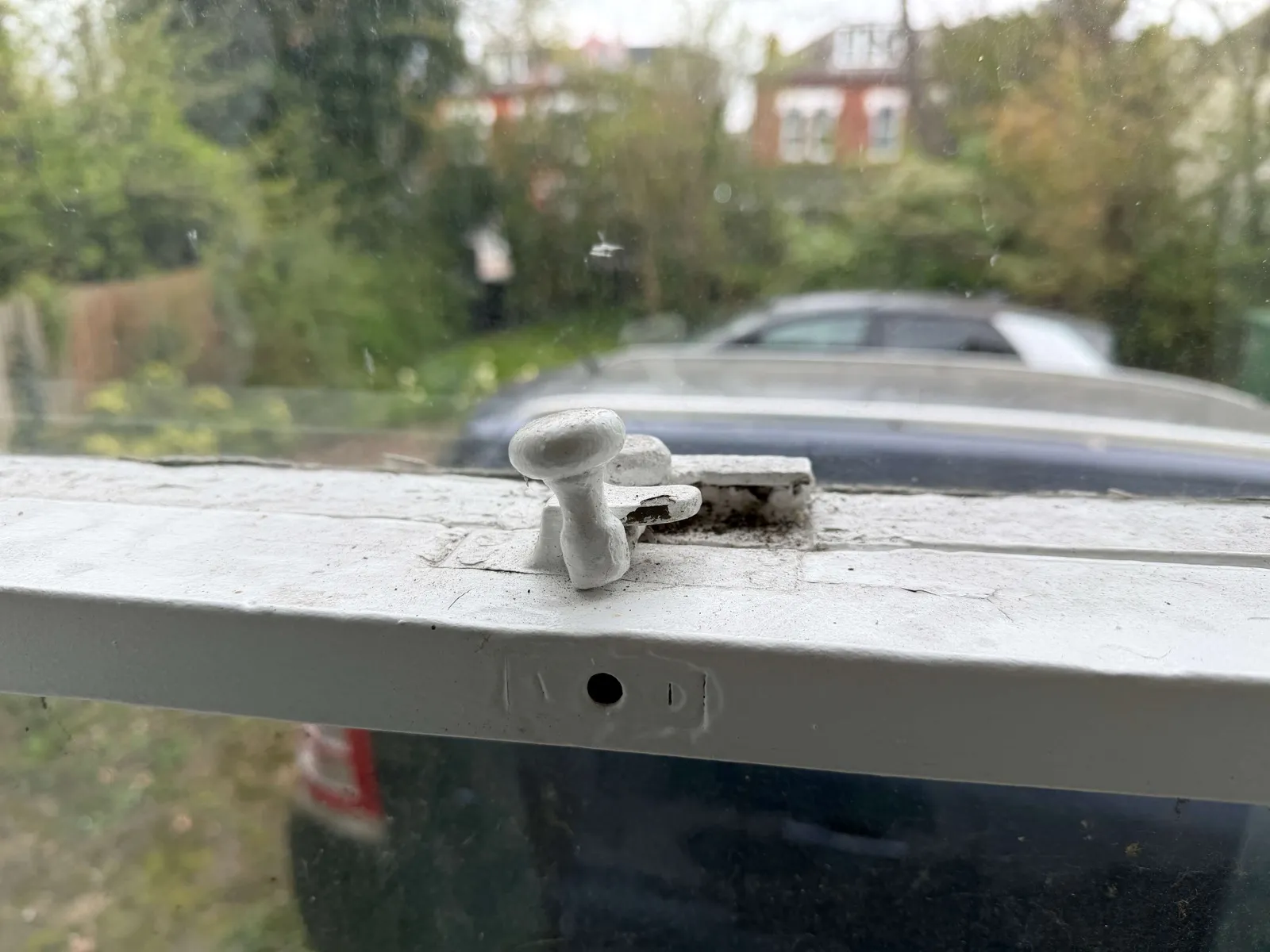
The fastener in the photo above is a familiar sight in older Hertfordshire homes: a Victorian-era sash lock that’s been painted over so many times it can barely turn. It’s still doing its job — just about — but the original brass or wrought-iron detail underneath is hidden, the mechanism is sticky, and the security it once provided is compromised.
Sash window locks aren’t just hardware. They’re part of the architectural character of period properties, and getting them right matters for authenticity, security, and day-to-day usability. Here’s a quick tour of the main designs you’ll find on traditional sash windows, and what to do when they’ve seen better days.
The Fitch fastener (the one in the photo)
The Fitch fastener is the most common traditional sash window lock — invented in 1880 by William Fitch and fitted to most Victorian and Edwardian sashes since. It sits across the meeting rail where the upper and lower sashes overlap. A small cam-shaped lever turns through 90° to hook a strike plate, which simultaneously locks the window and pulls the two sashes tight together — closing any gap and reducing rattles.
If yours looks like the one above — buried in a century of paintwork, the mushroom-knob barely turning — it can almost certainly be restored. Stripping back the paint, freeing the spindle, and re-polishing the brass typically brings these back to full working order. Replacement reproductions are also widely available in matching styles.
Brighton sash fastener
A heavier, more decorative cousin of the Fitch. The Brighton fastener uses a screw-down barrel that physically draws the sashes together when tightened. Common on grander Georgian and early Victorian properties because of its more substantial appearance. Slower to operate than a Fitch, but provides excellent rattle reduction and a satisfying mechanical feel.
Sash stops (cylinder restrictors)
These are the small drilled-cylinder locks you’ll see fitted into the upper sash from inside — note the drilled hole visible just below the painted-over Fitch in the photo. A small key-operated cylinder is recessed into the timber; turning it deploys a stainless steel pin that prevents the sash from sliding past a set point.
Sash stops serve two purposes:
- Security: a thief can’t slide the lower sash up far enough to climb through, even if the main fastener has been forced.
- Child safety: the window can be left open a few inches for ventilation without it being opened wide enough for a child to fall.
If you’re restoring sash windows in Hertfordshire, fitting modern sash stops alongside the original Fitch is one of the most cost-effective security upgrades available.
Sash lifts and ring pulls
Strictly handles rather than locks, but worth mentioning because they’re often replaced or lost during restoration. Sash lifts are the curved or D-shaped handles fitted to the bottom rail of the lower sash for raising it; ring pulls sit on the top rail of the upper sash so it can be pulled down. Period-correct reproductions in brass, chrome, or wrought iron are easily sourced and finish the window properly.
Why traditional locks get painted over (and what to do about it)
The fastener in the photo above tells a story: every redecoration cycle for ~120 years, the painter taped over the moving parts loosely or not at all, and another layer of paint glued the mechanism a little more solid. Eventually the cam barely turns, the strike plate is encrusted, and the only “fix” most homeowners can think of is to rip it off and fit a modern UPVC-style alternative.
That’s almost always the wrong move. The original mechanism is usually salvageable, and replacing it with a generic modern lock destroys both the look and the resale value of a period property.
The right approach for a paint-clogged lock is the same approach we recommend for rotten timber sash windows: assess first, restore where possible, replace only where needed.
When we restore a window with painted-over hardware, we typically:
- Carefully strip the paint from the lock mechanism and surrounding timber using heat guns and chemical strippers (see our guide to painting wooden windows for what not to do next time).
- Free the spindle, clean the cam and strike plate, and lubricate the moving parts.
- Re-polish the original brass or wrought iron — or, if it’s beyond saving, source a period-matched reproduction.
- Mask the mechanism properly during the redecoration so it doesn’t get painted in again.
For more on how the lock fits into the broader anatomy of a sash window, see our overview of sash window parts.
When to call us
If your sash window locks look anything like the one in the photo — painted shut, missing fittings, or compromised security — we can almost certainly restore them as part of a wider window restoration project. Get in touch for a free assessment, or call us on 01727 638 999.